



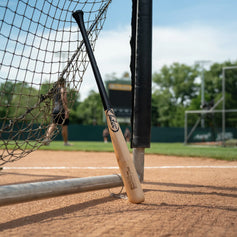
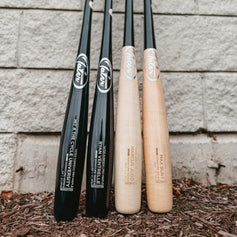
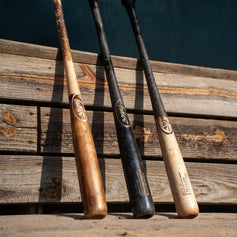


If you've never watched a wood bat get built, the entire process takes about 45 minutes from raw billet to finished bat. Done well, you can't tell on the outside how much craft went into it. Done poorly, the bat tells you on the first inside fastball.
We ship 500-1,000 bats a week out of our Connecticut shop. Each one moves through the same eight stages whether it's a stock 271 or a custom Kurtz-spec torpedo. Here's the real version of how it happens.
Step 1: Sourcing the billet
A "billet" is the raw cylinder of wood that becomes a bat — typically 37" long, 2.75" in diameter, weighing around 90 ounces. MLB-grade billets go through three filters: species/origin, slope of grain (max 3° on maple per the ink-dot rule), and density/weight calibration against the target spec.
Step 2: Inspection and grading
Every billet that arrives gets inspected by hand. We reject roughly 5-10% of incoming stock for cosmetic or structural issues. Better to lose the cost of the billet than ship a compromised bat.
Step 3: Turning on the lathe
This is the step that makes a billet a bat. We use CNC-controlled lathes programmed with the exact profile of each turn model — 271, 110, AP5, 243, our X-series, the torpedo profiles. The reason for CNC instead of pure hand-turning: consistency. A pro hitter ordering 6 bats of the same spec wants all 6 to feel identical.
Step 4: Cupping (or not)
Cupping is the small concave dish drilled into the end of the barrel. It removes a few grams of wood from the end, shifting the balance point toward the hands. We standardize at roughly 7/16" unless a customer specifies otherwise.
Step 5: Sanding and finishing
After the lathe, the bat moves to hand sanding through progressively finer grits (120, 220, 320, 400). The finish is a multi-stage process: wood-conditioner pre-treatment, base color or stain (clear or pigmented), 2-3 coats of high-build polyurethane, and a final bone-rub that gives the bat the hard, smooth pro feel that defines a Tater bat.
Step 6: Ink-dot certification (maple bats only)
Every MLB-grade maple bat carries an ink dot. The ink-bleed pattern reveals the slope of the wood grain — tight bleed means safe shallow slope, fast bleed means dangerous steep slope. Introduced in 2008 after a spike in dangerous shatter events. Every Tater maple bat passes ink-dot certification before it ships.
Step 7: Engraving and personalization
For custom builds, engraving comes after finish. We use laser engraving so it sits beneath the finish coat and won't wear off. Standard is up to four lines of text per bat.
Step 8: Final QA and shipping
Weight verified (±0.5 oz), length verified (±1/16"), visual inspection, hand-feel check, photographed for the customer's order record. If anything is out of spec, it goes back to the floor. Typical custom build ships in 10-14 business days.
Why this matters for what you swing
Every step is a decision point that affects how your bat performs. The customer-side outcome: when you order a custom Tater, the bat that arrives is the bat we'd swing ourselves. Same wood, same process, same QA, whether you're an MLB player or a 14-year-old at your local high school.
FAQ
How long does it take to make a custom wood baseball bat?
The physical production takes roughly 45 minutes of active work spread across multiple stations. Total time from order to ship at Tater is 10-14 business days (2-3 weeks). Stock bats ship in 2-3 business days.
Why are some maple bats inked-dotted and others aren't?
Every MLB-grade maple bat carries an ink-dot certification mark, introduced after the 2008 MLB rule change addressing dangerous shatter events. The dot's bleed pattern reveals the slope of grain. Non-MLB-spec maple bats skip the certification. Every Tater maple bat passes.
What's the difference between CNC-turned and hand-turned bats?
CNC bats are nearly identical bat-to-bat — what pros want when ordering 6 of the same spec. Hand-turned bats have measurable variance some traditionalists prefer. We use CNC for turning consistency, but inspection, finishing, engraving, and final hand-rubbing are all manual.
Tater Baseball builds custom wood bats in Connecticut — family-owned since 2015, 500-1,000 bats a week, MLB-supplier grade. Build yours at the Custom Wood Bat Builder.




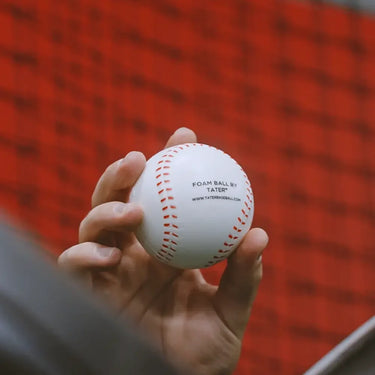
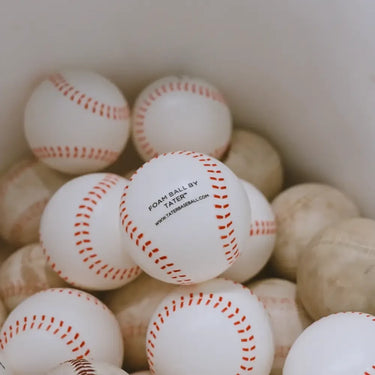


Pelota de espuma Tater® de Tater Baseball® | Pelotas para máquina de lanzar
$ 74.99
A partir de $ 59.99
/


