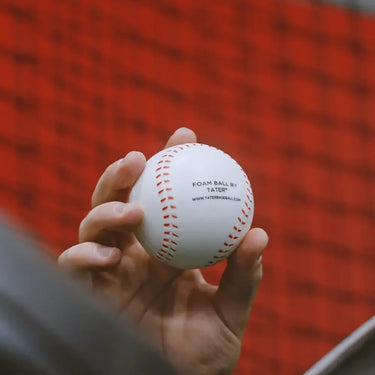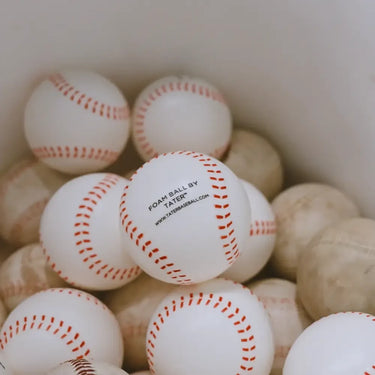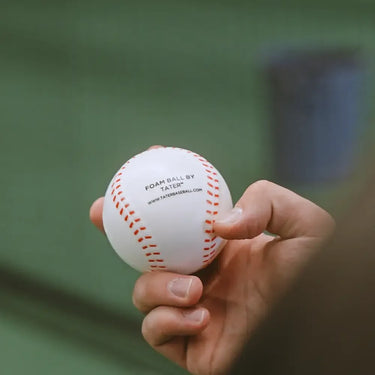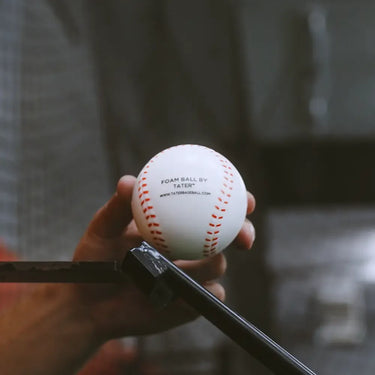
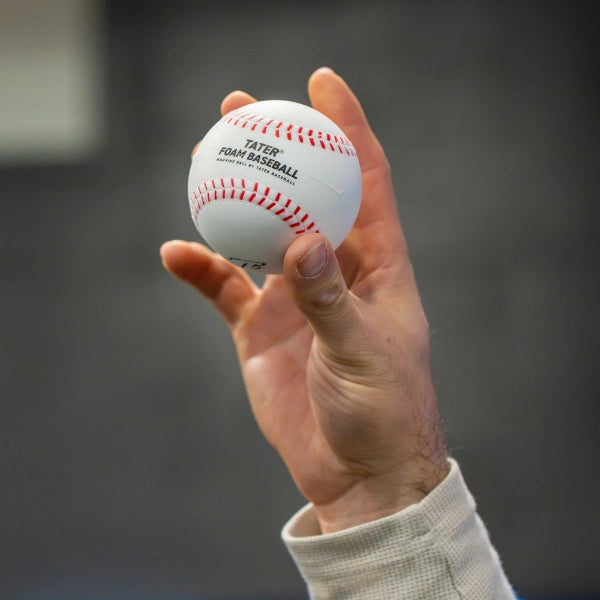
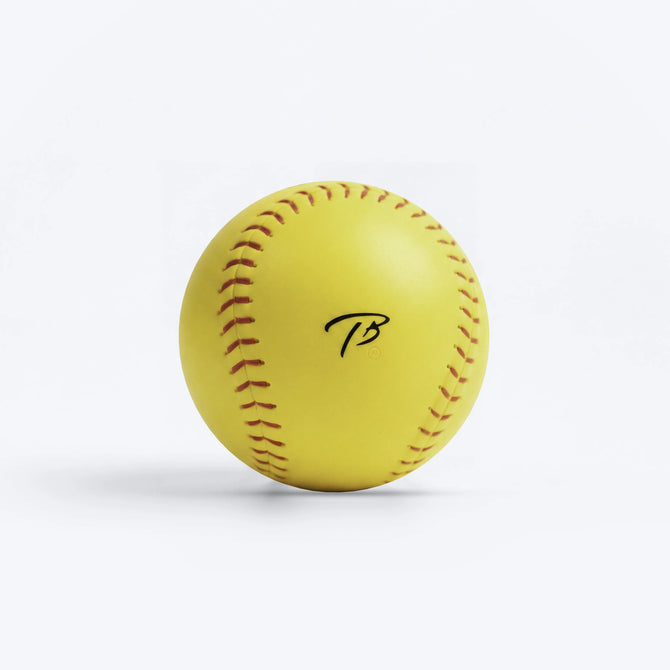

The Tater® Foam Ball weighs 5 oz, the same as a real baseball, because weight decides how a foam ball flies off a pitching machine. Most foam baseballs weigh 3.6 oz or less. Here's what regulation weight is, why it matters for machine work and how each of our training balls compares.
Regulation ball weights
| Ball | Regulation weight | Rulebooks |
|---|---|---|
| Baseball | 5 to 5¼ oz | MLB, NCAA, NFHS, Little League |
| Softball (12") | 6.25 to 7.0 oz | USA Softball, NCAA, NFHS |
Every level of baseball, from Little League to MLB, plays with a ball inside that same 5 to 5¼ oz window. The whole game is built around it: how the ball comes out of a pitcher's hand, how it carries and how it feels on the barrel.
Why foam ball weight matters
A pitching machine throws by squeezing the ball between spinning wheels. A light foam ball comes off those wheels differently than a game ball. At higher speeds it can rise, sink or cut on the way to the plate, a flight path you'll never see in a game.
Train against that all winter and your eyes learn the wrong ball. A foam ball at game weight fixes that:
- It flies like a game ball. The flight path you see from the machine is the one you'll see in an at-bat.
- It builds real timing. You time it like a game ball, so the reps carry over to the plate.
- It gives honest feedback. A mishit looks like a mishit, instead of a light ball carrying off weak contact.
Our training balls by weight
| Ball | Weight | Cover | Best for |
|---|---|---|---|
| Tater Foam Ball | 5 oz (regulation) | Foam | High-volume cage, garage and indoor machine work, with no sting |
| Tater Foam Core Ball | 4.5 oz (near game weight) | Genuine leather, Kevlar-stitched seams | Breaking-ball machine work with game-ball feel and a foam core |
| Tater Foam Softball | 6.5 oz (regulation) | Foam | Fastpitch and slowpitch machine work for softball hitters |
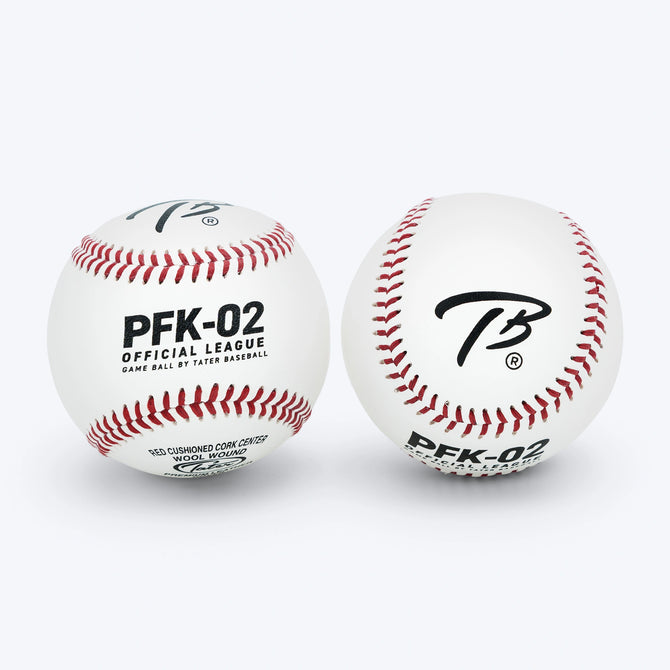
| Tater PFK-02 Game Ball | 5 oz (regulation) | Full-grain leather, cork center | High school games and scrimmages, not machine work |
The Foam Ball: regulation weight, no sting
The Tater Foam Ball is the one to grab for most machine work. At 5 oz it holds its line at 95+ mph, without the late rise, cut or sink you get from light foam. The vibration-dampening foam takes the shock out of contact, so hitters can swing with full intent without hand or wrist pain, and it's safe for indoor cages, gyms, garages and backyards. It's sold by the dozen, in 1, 2, 5 or 10 dozen.
Why coaches run them in their cages: Why Coaches Need Tater Foam Balls, and how one facility uses 40 dozen: The Natural Ballplayer.
The Foam Core Ball: leather for breaking balls
The Foam Core Ball wraps the same foam core in a genuine leather cover with Kevlar-stitched seams. At 4.5 oz it's close to game weight, and the leather lets the machine grip real spin, so curveballs, sliders and changeups move the way they do in games. Pick it when you want breaking-ball work with game-ball feel; pick the Foam Ball when you want full regulation weight and the most reps.
The Foam Softball: regulation weight for softball
The Foam Softball weighs 6.5 oz, inside regulation softball weight. It feeds through fastpitch and slowpitch machines at up to 70+ mph and handles fastballs, rise balls, drop balls and changeups. More in Tater® Foam Softballs: Regulation Weight Without the Sting.
Training ball or game ball?
Foam training balls are for the cage, not for games. For game day, the PFK-02 is our high school game ball: 5 oz, 9" around, full-grain leather and a cushioned cork center, built to NFHS-level construction. Game balls aren't built for high-volume machine work, so keep the leather for games and the foam for the cage.
See every ball in our baseballs collection.
FAQ
How much does a regulation baseball weigh?
5 to 5¼ oz, under MLB, NCAA, NFHS and Little League rules. The Tater® Foam Ball and the PFK-02 game ball are both 5 oz.
How much does a regulation softball weigh?
A 12" softball weighs about 6.25 to 7.0 oz. Our Foam Softball is 6.5 oz, inside that range.
Why does foam ball weight matter for pitching machines?
A machine throws by squeezing the ball between spinning wheels. A light foam ball comes off the wheels differently and can rise, sink or cut on its way in. A foam ball at game weight flies like a game ball, so the reps carry over.
What's the difference between a 3.6 oz and a 5 oz foam baseball?
The 5 oz ball is regulation weight; the 3.6 oz ball is 28% lighter. The 5 oz ball flies like a real baseball off the machine, while a light ball is more likely to rise or move.
Foam Ball or Foam Core Ball?
The Foam Ball is all foam and 5 oz, for high-volume, no-sting machine work. The Foam Core Ball adds a leather cover and Kevlar seams at 4.5 oz, for breaking balls with game-ball feel.
Can I use foam balls in games?
No. Foam balls are for training. For games, use a regulation leather ball like the PFK-02.
Key takeaways
- A regulation baseball weighs 5 to 5¼ oz and a 12-inch softball about 6.25 to 7.0 oz; most foam baseballs weigh 3.6 oz or less.
- Light foam balls can rise, sink or cut off a pitching machine; a foam ball at game weight flies like a game ball.
- The Tater® Foam Ball is 5 oz, the Foam Softball 6.5 oz, the Foam Core Ball 4.5 oz with a leather cover, and the PFK-02 is the 5 oz game ball.
Tater Baseball makes regulation 5 oz foam pitching machine baseballs, 6.5 oz foam softballs, foam core leather training balls, and NFHS-level game balls. Browse the full baseballs collection.
Best seller

Best seller


+3
Best seller