

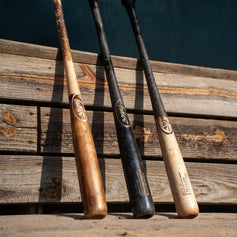


If you've watched a single MLB at-bat in the last year, you've probably already seen a torpedo bat — even if you didn't know what you were looking at.
The shape is the giveaway. Instead of the slow, even taper you'd expect on a 271 or an AP5, the barrel on a torpedo bat is wider where the sweet spot lives — roughly six inches in from the end cap — and narrower above and below. From the side it looks like the bat got pinched in the middle and pushed out where the hitter actually makes contact. That's the entire idea.
We've been building torpedo wood bats in our Connecticut shop since before they were a trend. This is the short version of how the shape actually works, why it pops the way it does, and which hitter it's built for.
What a torpedo bat actually does
Every wood bat has a finite amount of mass — usually 28 to 32 ounces of it, depending on length, drop, and species. A traditional bat puts the bulk of that mass out toward the end cap. That's where end-loaded power bats get their commitment-heavy feel and why mishits closer to the hands sting and die.
A torpedo bat takes that same total mass and moves it. Instead of loading the end, the wood-turner concentrates the meat of the barrel directly at the hitter's natural contact zone, then tapers the wood up toward the cap and back down toward the hands. The total weight on the scale doesn't change much. The center of mass moves.
You feel two things at the plate:
- A bigger effective sweet spot. The fattest part of the bat is right where you swing, not three inches past it. Mishits that would have died as weak fly-outs now leave the barrel with real exit velocity.
- A balanced swing weight. Without the end-loaded mass dragging the head through, the swing feels quicker through the zone — closer to a balanced 271 than to an end-loaded AP5.
That combination — explosive pop, balanced feel — is why hitters started moving to the shape in the first place. It's not a gimmick. It's geometry.
Why the torpedo took over in 2025
Torpedo barrels existed in pro bat shops for years before the public noticed. The reason the format went mainstream is that a few MLB hitters started swinging them on national TV in the 2025 season, put up loud offensive numbers, and the rest of the league started asking for them. Bat makers who'd been building one or two torpedo SKUs as specialty pieces suddenly had a product to ship at scale.
The downstream effect: college, travel ball, and high school hitters are now asking for the same profile. Wood-bat-rule leagues see torpedo as the new standard sweet-spot bat. Big aluminum-bat brands are launching torpedo composites to match the feel.
We didn't invent the torpedo. But we were one of the first shops cutting them out of Connecticut maple, and we've been turning the profile long enough to know what works on it and what doesn't.
Why we build the Tater Torpedo in maple only
The biggest design constraint on a torpedo barrel is that the sections of wood above and below the sweet spot are thinner than they'd be on a traditional bat. The shape only works if those thinner sections can handle the impact force of an inside pitch or a high mishit.
Maple has higher natural density than birch or ash. On a traditional barrel shape, that density doesn't matter much — both species hold up fine. On a torpedo, it does. The denser maple holds those thinner sections together at velocity; birch and ash flex more, which is great on a balanced bat but creates break risk on a torpedo profile.
That's why every Tater Torpedo bat is cut from MLB-grade maple. Not because we don't like birch — our birch bats outsell our maple bats in some lines — but because birch on a torpedo barrel is a structural compromise we won't ship.
Drop weight: why we recommend Drop 2 (not Drop 3)
This is the part most torpedo write-ups skip and it matters.
The torpedo profile shifts mass into the barrel center. That makes the barrel relatively heavier than the rest of the bat compared to a traditional turn. On a Drop 3 bat (the standard BBCOR/college/HS spec), the total weight is light enough that holding the torpedo's barrel mass together starts to push the limits of the thinner sections above and below the sweet spot.
On a Drop 2 — one more ounce of total mass — those sections have more wood to work with. You get the full benefit of the torpedo shape and you cut break risk significantly. Same feel through the zone, just with more durability behind it.
We sell torpedo bats in Drop 3, but we'll always recommend Drop 2 as the default unless the league rules require Drop 3.
Is a torpedo bat right for you?
A torpedo isn't the right bat for every hitter. Use this rough guide:
- Yes, swing a torpedo: You've got the bat speed and timing to handle a balanced profile, you want more forgiveness on mis-hits, you've been swinging a 271 or balanced bat and want more pop. You're advanced enough that the slightly thinner sections aren't going to scare you.
- Maybe, but consider an alternative: You're a pure power hitter who wants to feel the barrel through contact. The XL5 Pro (end-loaded AP5 silhouette) might suit you better. You'll still get the pop, you'll just feel it through the end of the bat instead of the middle.
- Probably not yet: You're transitioning from metal to wood for the first time, you're still building bat speed, or you're a contact hitter who lives off control. Start with the X4 Pro (balanced) or the X24 Pro (271 turn). Get the feel of wood first. The torpedo will be there when you're ready for it.
If you're not sure which one fits your swing, our Bat Finder walks through the same questions we'd ask if you called the shop.
Pro tip from the shop floor
One thing we tell every customer ordering their first Tater Torpedo: treat the contact zone with respect. The sweet spot is bigger and more forgiving than on a traditional bat — but it's still wood. Inside pitches that catch the thin section near the cap are the main break risk. Stay on top of the ball, drive through the zone, and a Tater Torpedo will last you a season of cage work and competitive games.
Use a bat care routine you'd use on any pro-grade maple bat — wipe down after games, avoid leaving it in extreme cold or hot car trunks, rotate the logo to the sky on contact. Our wood bat care guide walks through the full routine.
FAQ
What's the difference between a torpedo bat and a traditional wood bat?
A traditional wood bat puts most of its mass at the end cap, which creates end-loaded power but a smaller effective sweet spot. A torpedo bat moves that mass into the hitter's natural contact zone — roughly six inches down from the end cap — and tapers the wood above and below. The total weight on the scale stays the same. What changes is where the mass lives. The result is a bigger effective sweet spot, more forgiveness on mishits, and a balanced swing feel similar to a 271 turn.
Why are torpedo bats only built in maple?
The torpedo barrel shape requires denser wood to handle the thinner sections above and below the sweet spot. Maple has higher natural density than birch or ash, which keeps those sections structurally sound at high velocity. Birch and ash both flex more than maple, which is great for forgiveness on a balanced bat but creates real break risk on a torpedo profile. That's why every Tater Torpedo is cut from MLB-grade maple. No birch torpedo from us — we won't ship a bat we wouldn't swing ourselves.
What drop weight should I order a torpedo bat in?
We recommend Drop 2 over Drop 3 on every torpedo build. The extra ounce of total mass gives the barrel sections above and below the sweet spot more wood to work with, which extends bat life significantly without changing how the bat feels through the zone. If your league rules require Drop 3 (most BBCOR HS and college baseball), order Drop 3 — just know the break window is tighter. If your league allows Drop 2, take it.
Tater Baseball builds custom wood bats in Connecticut, family-owned since 2015 and ships 500-1,000 bats a week to hitters from youth baseball to MLB. Build your own torpedo at the Custom Wood Bat Builder, or grab one off the shelf at the Tater Torpedo product page. Made in Connecticut, swung in MLB.
Best seller


Best seller



30
31
32
+3
Best seller