

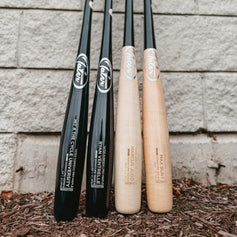
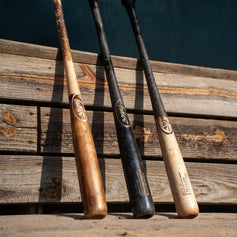


Wood bat species is the first real decision a hitter has to make — before turn model, before drop weight, before colorway. Get the species right and the bat feels like an extension of your hands. Get it wrong and the bat fights you all season.
We turn every Tater bat out of MLB-grade maple, birch, or ash. We've been doing it since 2015, 500-1,000 bats a week. Here's the honest, no-marketing-fluff version of how the three species actually compare and which one is right for which hitter.
The short answer (if you're in a hurry)
- Maple: Hardest, densest. Best for power hitters who want a hard barrel and the loudest crack. The pro standard.
- Birch: Slightly more flexible. More forgiving on mishits. Splits before it shatters. The smart pick for hitters transitioning from metal to wood.
- Ash: Lightest. Best feel and bat speed. The original wood-bat species, now niche. Best for contact hitters and traditionalists.
The rest of this guide is the detail behind each one.
Maple — the modern pro standard
Maple took over MLB bat racks in the late 1990s and never gave the title back. The reason is density: a hard maple billet is roughly 10-15% denser than ash, which translates directly into a harder barrel surface and a louder, cleaner crack on contact. Pop is the number one reason hitters move to maple.
The trade-off is durability profile. Maple is hard, but when it breaks, it tends to break catastrophically — sudden barrel snap rather than gradual splitting. The 2008 ink-dot rule (which all our maple bats meet) was specifically introduced to ensure the slope of grain in maple bats stays within safe limits and the bats break more predictably. We hold to that ink dot certification on every maple bat we ship, no exceptions.
Hard maple vs sugar maple: These are the same species — sugar maple (Acer saccharum), also called hard maple or rock maple — and the same wood that goes into MLB pro bats. When you see "hard maple" on a Tater PDP, that's what we mean. Soft maple is a different species and doesn't make the cut.
Who picks maple:
- Power hitters chasing exit velocity and pop
- Anyone swinging an end-loaded turn model (XL5, 243, CB15)
- Every hitter using a torpedo bat (we build the torpedo in maple only — see the species constraint section below)
- Pros and serious players who care about feel-on-contact more than maximum forgiveness
Birch — the smart middle ground
Birch sits between maple and ash on every spec that matters. Slightly less dense than maple, slightly heavier than ash. Slightly more flexible than maple, less flex than ash. Slightly cheaper than maple, comparable to ash.
What makes birch special: it splits rather than shatters. When a birch bat reaches its breaking point, the wood fibers separate gradually instead of catastrophically. You'll see hairline cracks before total failure, which gives you a chance to pull the bat from games before it ends a swing in a dangerous way.
The flexibility also means birch is more forgiving on mishits. A bad swing off the end of a maple bat sends a vibration up the handle that can rattle your hands. The same swing on birch dissipates more of that energy in the wood itself. You feel the difference immediately.
If you're transitioning from a metal bat (BBCOR, USSSA, USA aluminum) to wood for the first time, we usually point you to birch first. The forgiveness window is wider, and the swing weight is closer to what aluminum players are used to.
Who picks birch:
- Players transitioning from metal to wood
- High school and college hitters who want forgiveness on mishits
- Anyone who'd rather see a split coming than a clean snap
- Most balanced turn models (X4, X24, J21) work great in birch
Ash — the original (and still relevant)
Ash was the wood the major leagues was built on. The species has the lightest density of the three, which translates to the lightest swing weight per ounce of mass — meaning a 33-ounce ash bat will feel quicker through the zone than a 33-ounce maple bat.
Ash also gives the most "feel" through contact. The wood's natural fiber structure flexes more on impact, which transmits more sensation up the handle. Hitters who care about feeling what the ball did to the bat — barrel center vs end vs handle — often prefer ash. You know immediately if you got it right.
The downside is durability. Ash flakes — the wood fibers separate at the surface over time, especially in dry climates. You'll see ash bats with the barrel finish coming off in thin strips after heavy use.
Production-side note: the emerald ash borer beetle has decimated North American ash forests since the mid-2000s. Expect ash to slowly become a niche product across the industry.
Why we build the Torpedo in maple only
One last point because it comes up constantly. Our Tater Torpedo bat is built in maple only — we don't offer a birch or ash version, and we won't. The torpedo barrel concentrates mass at the sweet spot, which means the wood above and below the contact zone is thinner than on a traditional bat. Those thinner sections need maple's density to hold structural integrity at high velocity. Read more in our torpedo bat explainer.
Side-by-side: the three species at a glance
| Spec | Maple | Birch | Ash |
|---|---|---|---|
| Density | Highest | Mid | Lowest |
| Flex on impact | Least | Mid | Most |
| Mishit forgiveness | Lowest | Highest | Mid |
| Break style | Catastrophic snap | Splits gradually | Flakes over time |
| Pop / exit velocity | Highest | Mid-high | Mid |
| Pro popularity (MLB) | ~70% | ~25% | ~5% |
How we'd pick
- "I'm transitioning from metal." → Birch.
- "I want maximum pop." → Maple.
- "I'm a contact hitter." → Birch or ash.
- "I'm getting a Torpedo." → Maple only.
- "I break a lot of bats." → Birch.
- "I want a pro feel." → Maple.
Start your build at the Custom Wood Bat Builder.
FAQ
Is maple or birch better for a baseball bat?
It depends on what you optimize for. Maple gives you higher density, harder barrel, more pop on contact, and the loudest crack — which is why it's the dominant species in MLB bat racks. Birch gives you more flex on impact, more forgiveness on mishits, and a split-rather-than-shatter failure mode. Power hitters and pros tend to choose maple. Hitters transitioning from metal or wanting more forgiveness tend to choose birch.
What's the difference between hard maple and sugar maple?
They're the same wood. Sugar maple (Acer saccharum), also called hard maple or rock maple, is the species used in MLB-grade pro bats.
Are ash bats still worth buying?
Yes, but with caveats. Ash gives you the lightest swing weight per ounce of mass and the best feel through contact. The downside is supply: the emerald ash borer beetle has materially tightened the ash billet supply since the mid-2000s.
Tater Baseball builds custom wood bats in Connecticut — maple, birch, and ash — family-owned since 2015. Build yours at the Custom Wood Bat Builder. Made in Connecticut, swung in MLB.
Best seller


Best seller



30
31
32
+3
Best seller